Universitas Gadjah Mada UNIVERSITAS GADJAH MADA
FACULTY OF AGRICULTURE
DEPARTMENT OF FISHERIES
BACHELOR IN FISH PRODUCT TECHNOLOGY
  • Home
  • Publication
Arsip:

Publication

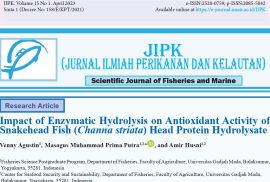
Impact of Enzymatic Hydrolysis on Antioxidant Activity of Snakehead Fish (Channa striata) Head Protein Hydrolysate

Publication Friday, 16 June 2023

Abstract

There is concern regarding the use of synthetic antioxidants which spurred the yearly increase of natural antioxidants to substitute synthetic ones. Fish protein hydrolysate (FPH), which has been reported to have potent antioxidant properties, could be utilized to solve this problem. This study aimed to utilize the by-product of snakehead fish (head) and determine the optimum hydrolysis conditions to obtain FPH with antioxidant activity. Two parameters were tested during the hydrolysis process: enzyme concentration (papain enzyme) and hydrolysis time. The optimum condition was evaluated by measuring dissolved protein, hydrolysis degree (DH), and antioxidant activity, including DPPH, ABTS, and FRAP. The optimal hydrolysis conditions were 5% enzyme concentration and 6 h of hydrolysis time at 55°C and pH 7.0. The DPPH, ABTS, and FRAP antioxidant activities were 50.70%, 66.67%, and 1.35 M Tr/mg, respectively. Based on the antioxidant activity, Snakehead fish head has the potential as a source of natural antioxidants. read more

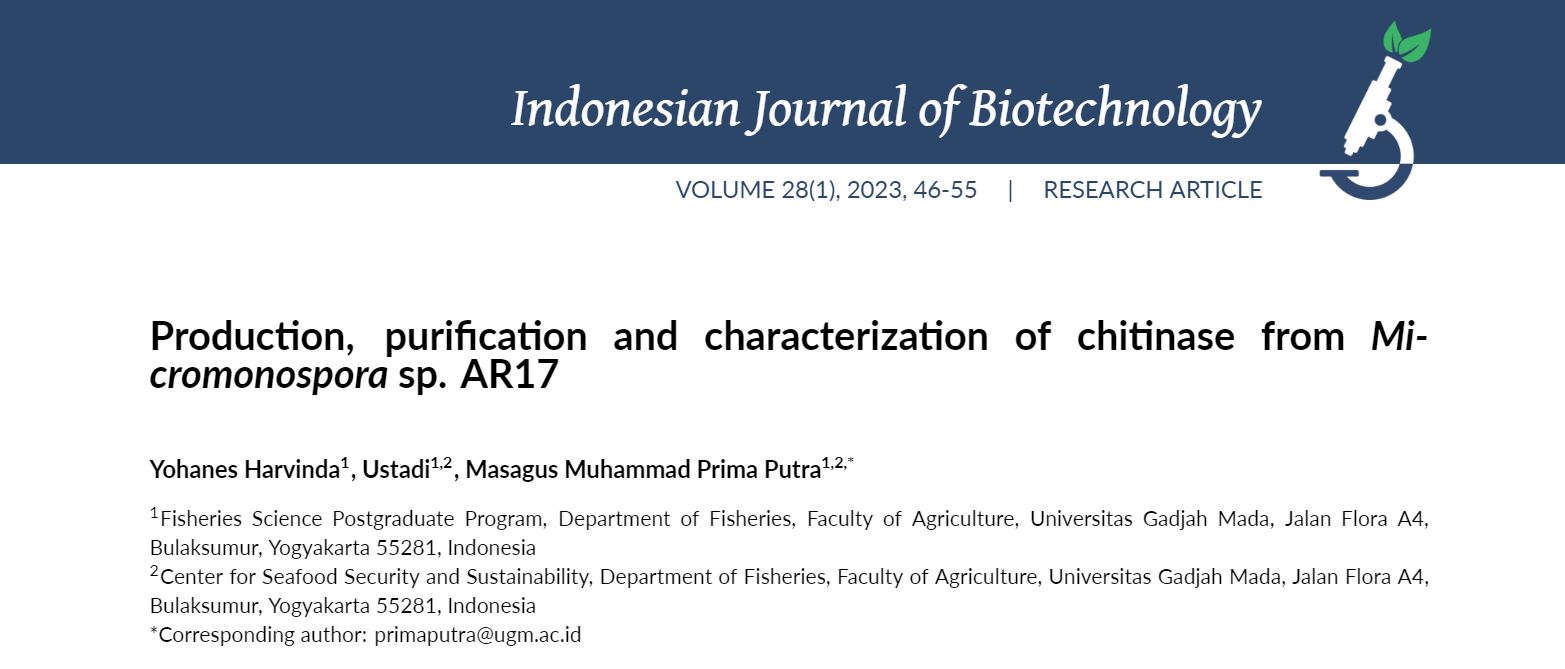
Production, purification and characterization of chitinase from Micromonospora sp. AR17

Publication Friday, 16 June 2023

Abstract

N‐acetylglucosamine (NAG) is the monomer product of chitin, which has been widely used as a bioactive com‐ pound in applications such as anti‐tumor, anti‐microbial, and antioxidant activities. In production, biological processes using enzymes are preferable to chemicals due to environmental issues. This study aims to determine the activity, purity level, and molecular weight of purified chitinase from Micromonospora sp. AR17 determines the concentration of NAG produced by purified chitinase that has been characterized. Chitinase was produced by fermentation in colloidal chitin broth at 40 °C, pH 7, for 7 days, while chitinase activity was checked every 24 h. The optimal fermentation time was used to produce chitinase for a further purification step. Enzyme purification was carried out by ultrafiltration, ammonium sulfate precipitation, ion exchange chromatography (Q Sepharose Fast Flow), and gel filtration (Sephacryl S‐300). The purified enzyme was then char‐ acterized for optimum time, pH, and temperature to produce NAG. The results suggested that the fourth day was the optimal time for chitinase production, with chitinase activity of 0.0040 U/mL and a NAG concentration of 7.62 µg/mL. The purifica‐ tion step successfully increased the purity by 6.82 times with chitinase‐specific activity at 1.4648 U/mg. Production of NAG with purified chitinase produced a NAG concentration of 32.472 µg/mL with an incubation time of 30 min at 40 °C and pH 7. read more

In Vitro α-Amylase and α-Glucosidase Inhibitory Activity of Green Seaweed Halimeda tuna Extract from the Coast of Lhok Bubon, Aceh

InformationPublication Friday, 27 January 2023

Abstract

Seaweed belongs to marine biota and contains nutrients and secondary metabolites beneficial for health. This study aimed to determine the antidiabetic activity of extracts and fractions of green seaweed Halimeda tuna. The H. tuna sample was extracted with the maceration method using methanol and then partitioned using ethyl acetate and water to obtain ethyl acetate and water fractions. The methanol extract, ethyl acetate fraction, and water fraction of H. tuna were tested for their inhibitory activity against α-amilase and α-glucosidase. The methanol extract and the fractions with the highest inhibitory activity were phytochemically tested and analyzed using gas chromatography–mass spectrometry (GC-MS). The results showed that the ethyl acetate fraction (IC50 = 0.88 ± 0.20 mg/mL) inhibited α-amylase relatively similar to acarbose (IC50 = 0.76 ± 0.04 mg/mL). The methanol extract (IC50 = 0.05 ± 0.01 mg/mL) and the ethyl acetate fraction (IC50 = 0.01 ± 0.00 mg/mL) demonstrated stronger inhibitory activity against α-glucosidase than acarbose (IC50 = 0.27 ± 0.13 mg/mL). Phytochemical testing showed that the methanol extract and the ethyl acetate fraction contained secondary metabolites: alkaloids, flavonoids, steroids, and phenol hydroquinone. The compounds in methanol extract predicted to have inhibitory activity against α-amylase and α-glucosidase were Docosanol, Neophytadiene, Stigmasta-7,22-dien-3-ol,acetate,(3.beta.,5.alpha.,22E), Octadecanoic acid,2-oxo-,methyl ester, and phytol, while those in the ethyl acetate fraction were n-Nonadecane, Phytol, Butyl ester, 14-.Beta.-H-pregna, Octadecenoic acid, and Oleic acid. read more

Optimization Concentration of Irgacure® 2959 as Photo-initiator on Chitosan-Kappa-Carrageenan Based Hydrogel for Tissue Sealant

InformationPublication Monday, 2 January 2023

Optimization Concentration of Irgacure® 2959 as Photo-initiator on Chitosan-Kappa-Carrageenan Based Hydrogel for Tissue Sealant

Fiskina Zulfa Kamala, Wiratni Budhijanto, Eko Purnomo, Prihati Sih Nugraheni

Hydrogel is a three-dimensional network of hydrophilic polymers widely used in the biomedical field, one of which is a tissue sealant. The material that can be used in the manufacture of hydrogels is chitosan. The ability of chitosan in the formation of hydrogel is still limited by its swelling and adhesive properties, so it requires other materials such as crosslinkers, one of which is kappa-carrageenan which can stabilize and increase the viscosity of the hydrogel. The addition of Irgacure® 2959 as a photo-initiator to the hydrogel can produce free radicals that can bind to the active group of the polymer. This study aims to determine the effect of adding Irgacure® 2959 in the manufacture of hydrogel based on a chitosan-kappa-carrageenan solution formulated as a colon tissue adhesive. The treatments given were the addition of Irgacure® 2959 as much as 0%, 1%, 2%, 3%, and 4%. The characteristics of the hydrogel tested qualitatively (simulation adhesion test), degree of swelling, resistance to water, degree of crystallinity, and ability to inhibit bacterial growth. The addition of Irgacure® 2959 did not show significantly different results from the control that indicating it cannot increase the crosslinking between chitosan and kappa-carrageenan. This is predicted due to the presence of steric hindrance from kappa-carrageenan, causing very limited crosslinking due to the molecular size difference between chitosan and kappa-carrageenan. Further, it is necessary to optimize the ratio of the chitosan and kappa-carrageenan to get the balance ratio that supports the occurrence of cross-linking. read more

Optimization of Irgacure® 2959 Concentration as Photo-Initiator on Chitosan-Alginate Based Hydrogel for Colon Tissue Sealant

InformationPublication Monday, 2 January 2023

Optimization of Irgacure® 2959 Concentration as Photo-Initiator on Chitosan-Alginate Based Hydrogel for Colon Tissue Sealant

Diah Puspitasari, Wiratni Budhijanto, Eko Purnomo, Prihati Sih Nugraheni

Tissue sealant is a material that is used as an adhesive to bond two tissue surfaces used during surgery. Chitosan and alginate are natural macromolecules used to manufacture hydrogels as tissue sealants because these two materials can strengthen bonds and the mechanical properties of tissue sealants. Irgacure® 2959, as a photo-initiator, can strengthen the cross-linking between chitosan-alginate to produce a tissue sealant with good mechanical strength. Therefore, this study aims to determine the effect of adding Irgacure® 2959 to chitosan-alginate hydrogel with different concentrations as a tissue sealant designed for the colon. The experimental design used a completely randomized design (CRD) with the addition of Irgacure® 2959 0; 1; 2; 3; 4%. The characteristics of the hydrogel as a tissue covering observed in this study include the degree of swelling, water resistance, simulated adhesion, degree of crystallinity, and ability to inhibit bacteria. The results of this study showed that the addition of 4% Irgacure® 2959 reduced the degree of swelling, increased the hydrogel’s resistance to water, and increased adhesion. The interaction of chitosan and alginate with the addition of Irgacure® 2959 produces cross-links, as evidenced by a degree of crystallinity of 26.21%. Based on these results, the chitosan-alginate hydrogel with the addition of Irgacure® 2959 showed good potential in tissue sealant formulations, even though the inhibition of bacteria in all treatments showed low results, namely < 5 mm. read more

Publication in year 2022

InformationNewsPublication Tuesday, 27 December 2022

In 2022, FPT-SP actively publish in both national and international reputated journal as follows:

The effect of different drying methods on antioxidant compounds and fucoxanthin content of brown seaweed from the intertidal zone of West Aceh, Indonesia [2022] Mohamad Gazali, Muhammad Nursid, Amir Husni, Nurjanah, Neviaty P. Zamani, Zuriat, Citra Dina Febrina, Nabil Zurba, Hasanuddin Husin, Dio Hidayat Effect of Homogenization Process on the Production of Arthrospira platensis Carotenoid Nanocapsules Encapsulated with Arabic Gum and Whey Protein Concentrate [2022] K Alfionita, SA Budhiyanti, N Ekantari Jurnal Ilmiah Perikanan dan Kelautan 14 (1), 12-24 Formulation and stability of Ulva lactuca fatty acid oil in water (O/W) microemulsion [2022] Y. P. Ningrum, S. A. Budhiyanti Food Research 6 (4), 120-127

Optimization of Medium Composition for Streptomyces sp. PB2 Chitinase Production using Response Surface Methodology read more

Antioxidant, antidiabetic activities and consumer acceptance of Sargassum hystrix tea combined with cinnamon powder

NewsPublication Wednesday, 23 March 2022

Antioxidant, antidiabetic activities and consumer acceptance of Sargassum hystrix tea combined with cinnamon powder

Setiyawan, A. and Husni, A.

Abstract
Sargassum hystrix is a species of brown seaweed containing bioactive compounds and has the potential to be used as a functional drink. This study was aimed to determine the fucoidan content, antioxidant, antidiabetic activities, and consumer acceptance rate of combining cinnamon powder to manufacture S. hystrix seaweed tea. The process was carried out by washing, drying, cutting, blending, weighing, roasting, and packaging the seaweed. Furthermore, the seaweed was tested to determine the total phenolic content, antioxidant (scavenging of hydroxyl radical and superoxide anion), antidiabetic (inhibition of α-glucosidase and α-amylase) activities and sensory evaluation. The results showed that the addition of cinnamon powder affected the total phenol content, antioxidant and antidiabetic activities, and consumer acceptance of S. hystrix tea. Meanwhile, an increase in the amount (0 ~ 5%) of cinnamon powder reduced levels of antioxidants (46.90±0.92 to 39.53±0.11% for hydroxyl radical scavenging activity, and 82.00±1.19 to 73.56±1.23% for superoxide anion scavenging activity), with a rise in antidiabetic activity (22.27±1.74 to 83.98±2.37% for inhibition activity of α-glucosidase and 72.94±1.55 to 95.83±1.06% for inhibition activity of α-amylase). In addition, the use of 5% and 2% cinnamon powder has the ability to overcome the fishy smell and taste, respectively. read more

The impact of immersion time in lime solution on antioxidant and antidiabetic properties and consumer evaluation of Sargassum hystrix seaweed tea

NewsPublication Friday, 14 January 2022

The impact of immersion time in lime solution on antioxidant and antidiabetic properties and consumer evaluation of Sargassum hystrix seaweed tea

Damayanti Rahmatika Pratiwi, Amir Husni

Abstract.

Sargassum hystrix is a brown seaweed that contains bioactive substances, such as antioxidant and antidiabetic compounds, and is used as a functional ingredient in the food industry. They are mostly found in Indonesian waters, growing along rocky shorelines. Since the beverages extracted from seaweed are found to be less preferred by consumers due to the fishy smell, efforts are needed to curtail this problem. Based on this condition, the lime solution immersion method is observed as a suitable approach to reduce the pungent smell. Therefore, this study aims to determine the effect of the immersion time of the lime solution on antioxidant and antidiabetic properties, as well as on consumers’ preference for S. hystrix tea. In this research, the variation of seaweed immersion time at 0, 4, 8, 12, and 16 min, was used in a lime solution of pH 5 at 85°C. Multiple analyses were further carried out on the beverage, including moisture and total phenol content, hedonic teat, and antioxidant property, such as inhibitions of DPPH (1,1-diphenyl-2-picrylhydrazyl), FRAP (ferric reduction antioxidant power), and α-glucosidase. The results indicated that the immersion time had no effect (p > 0.05) on the water content, although it significantly affected total phenol levels, antioxidant, and antidiabetic activities, as well as the consumer preference for S. hystrix tea (p < 0.05). The best quality was obtained at 16 min, which indicated water and total phenol contents at 3.10 ± 0.33% and 76.81±0.23 mg GAE g-1, with DPPH, FRAP, and α-lucosidase inhibition activities at 53.86±1.27%, 121.82±0.91 µM g-1 , and 52.86±0.89%, respectively. It also showed consumer evaluations for appearance, color, flavor, taste, and overall quality, at 4.39±0.91, 4.33±0.78, 4.08±1.23, 4.25±1.08, and 4.26+0.13, respectively. Furthermore, immersion time in lime solution improved the quality and consumer evaluation of S. hystrix tea. read more

THE POTENCY OF CHITOSAN AS AN ELICITOR ON ANTIBACTERIAL ACTIVITY OF Streptomyces sp. GMR-22 AGAINST HISTAMINE-PRODUCING BACTERIA

Publication Sunday, 3 October 2021

Mohamad Aji Ikhrami1, Jaka Widada2, Indun Dewi Puspita1 and Masagus Muhammad
Prima Putra1*

1Fish Product Technology, Department of Fisheries, Faculty of Agriculture, Universitas Gadjah
Mada, Jl. Flora gedung A4, Bulaksumur Yogyakarta 55281
2Department of Agricultural Microbiology, Faculty of Agriculture, Universitas Gadjah Mada, Jl.
Flora gedung A4, Bulaksumur Yogyakarta 55281
*Corresponding author, e-mail: primaputra@ugm.ac.id

ABSTRACT
Streptomyces is a Gram-positive bacteria that produces the largest secondary metabolite
compounds. The results of whole-genome sequence analysis showed that Streptomyces can carry
more than 30 Biosynthetic Gene Clusters (BGC) encoding secondary metabolites that have the
potential to be explored in the exploration for new bioactive compounds. However, not all BGC
can be expressed in the laboratory scale and requires a specific activation method. This study aims
to explore the potential of chitosan as an elicitor compound to activate and or increase the
antibacterial activity of Streptomyces sp. GMR-22 was tested against histamine-producing bacteria
(HPB) Morganella morganii TK7 and Citrobacter freundii CK1. Chitosan was added to the
fermentation medium with the final concentration of 250, 500, and 750 μg/ml while without the
addition of chitosan used as control. Fermentation was carried out for 10 days at room temperature,
with constant agitation 200 rpm. The supernatant was separated by centrifugation at 3500 rpm for
15 minutes, then fractionation with ethyl acetate, concentrated by vacuum rotary evaporator, and
freeze-dried. The test for antibacterial activity was carried out by the microdilution method with
an extract concentration of 100 mg/ml. The test results of the microdilution method showed that
the addition of chitosan successfully increases the antibacterial activity with the highest activity
shown by the water fraction of 250 μg/ml addition of chitosan which is effective in inhibiting the
growth of Morganella morganii TK7 and Citrobacter freundii CK1 by 97,29% and 97,92%
respectively. read more

PERENDAMAN DALAM AIR 85 oC MENINGKATKAN AKTIVITAS ANTIOKSIDAN, ANTIDIABETES, DAN TINGKAT PENERIMAAN KONSUMEN TEH Sargassum crassifolium

Publication Thursday, 2 September 2021

Pris Larasati1, Amir Husni2*
1Departemen Perikanan Fakultas Pertanian Universitas Gadjah Mada
2Pusat Kajian Ketahanan dan Keberlanjutan Hasil Laut Departemen Perikanan Fakultas Pertanian
Universitas Gadjah Mada

Abstrak

Rumput laut Sargassum crassifolium mempunyai bioaktivitas yang tinggi sehingga berpotensi sebagai sumber pangan fungsional, salah satunya dibuat menjadi teh rumput laut. Salah satu kelemahan teh rumput laut yaitu kurang disukai konsumen karena adanya bau amis. Penelitian ini bertujuan untuk mengetahui pengaruh lama perendaman dalam air 85oC terhadap karakteristik dan tingkat penerimaan konsumen teh rumput laut S. crassifolium. Rancangan acak lengkap digunakan dalam penelitian ini, dengan perlakuan berupa variasi lama waktu perendaman. Teh rumput laut dibuat dengan cara merendam dalam air ±85oC selama 0, 4, 8, 12, dan 16 menit kemudian dipotong-potong lalu disangrai. Teh rumput laut S. crassifolium dianalisis meliputi: kadar air, total fenol, aktivitas antioksidan dengan metode 2,2-diphenyl-1-picrylhydrazyl (DPPH) dan Ferric Reducing Antioxidant Power (FRAP), aktivitas penghambatan α-glukosidase dan uji hedonik. Hasil penelitian menunjukkan bahwa lama perendaman berpengaruh nyata (p<0,05) terhadap kadar air, total fenol, aktivitas antioksidan, penghambatan α-glukosidase, dan tingkat penerimaan konsumen. Perlakuan terbaik yaitu lama perendaman 16 menit dengan kadar air 3,35±0,41%, total fenol 68,63±0,67 mg GAE/g, aktivitas penghambatan DPPH 55,99±1,01%, nilai FRAP 116,97±1,89 μM/g, penghambatan α-glukosidase 55,67±0,36%, dan nilai hedonik parameter aroma, rasa, warna, kenampakan, dan keseluruhan secara berturut-turut yaitu 4,29±1,18; 4,59±0,85; 4,18±0,98; 4,43±0,91; 4,37±0,98. read more

12

Link

 aspirations and feedback
aspirations and feedback


Recent Posts

  • FPT-SP lectures got best presenter award
  • Impact of Enzymatic Hydrolysis on Antioxidant Activity of Snakehead Fish (Channa striata) Head Protein Hydrolysate
  • Production, purification and characterization of chitinase from Micromonospora sp. AR17
  • In Vitro α-Amylase and α-Glucosidase Inhibitory Activity of Green Seaweed Halimeda tuna Extract from the Coast of Lhok Bubon, Aceh
  • Optimization Concentration of Irgacure® 2959 as Photo-initiator on Chitosan-Kappa-Carrageenan Based Hydrogel for Tissue Sealant

Archives

Universitas Gadjah Mada

Jl. Flora Gedung A4, Bulaksumur,

Caturtunggal, Kec. Depok, Kabupaten Sleman,

Daerah Istimewa Yogyakarta 55281

(0274) 551218
fish@ugm.ac.id

Download

Module Handbook

Manual Procedure Examination

Manual Procedure for Field Work

Manual Procedure for Undergraduate Thesis

Student Community Cervices Guide Book

Leaflet

Indonesian Society for Fisheries Processing Technology

Go to Website


Journal of Fisheries Sciences

Go to website


© Universitas Gadjah Mada

KEBIJAKAN PRIVASI/PRIVACY POLICY