Universitas Gadjah Mada UNIVERSITAS GADJAH MADA
FACULTY OF AGRICULTURE
DEPARTMENT OF FISHERIES
BACHELOR IN FISH PRODUCT TECHNOLOGY
  • Home
  • Information
Arsip:

Information

In Vitro α-Amylase and α-Glucosidase Inhibitory Activity of Green Seaweed Halimeda tuna Extract from the Coast of Lhok Bubon, Aceh

InformationPublication Friday, 27 January 2023

Abstract

Seaweed belongs to marine biota and contains nutrients and secondary metabolites beneficial for health. This study aimed to determine the antidiabetic activity of extracts and fractions of green seaweed Halimeda tuna. The H. tuna sample was extracted with the maceration method using methanol and then partitioned using ethyl acetate and water to obtain ethyl acetate and water fractions. The methanol extract, ethyl acetate fraction, and water fraction of H. tuna were tested for their inhibitory activity against α-amilase and α-glucosidase. The methanol extract and the fractions with the highest inhibitory activity were phytochemically tested and analyzed using gas chromatography–mass spectrometry (GC-MS). The results showed that the ethyl acetate fraction (IC50 = 0.88 ± 0.20 mg/mL) inhibited α-amylase relatively similar to acarbose (IC50 = 0.76 ± 0.04 mg/mL). The methanol extract (IC50 = 0.05 ± 0.01 mg/mL) and the ethyl acetate fraction (IC50 = 0.01 ± 0.00 mg/mL) demonstrated stronger inhibitory activity against α-glucosidase than acarbose (IC50 = 0.27 ± 0.13 mg/mL). Phytochemical testing showed that the methanol extract and the ethyl acetate fraction contained secondary metabolites: alkaloids, flavonoids, steroids, and phenol hydroquinone. The compounds in methanol extract predicted to have inhibitory activity against α-amylase and α-glucosidase were Docosanol, Neophytadiene, Stigmasta-7,22-dien-3-ol,acetate,(3.beta.,5.alpha.,22E), Octadecanoic acid,2-oxo-,methyl ester, and phytol, while those in the ethyl acetate fraction were n-Nonadecane, Phytol, Butyl ester, 14-.Beta.-H-pregna, Octadecenoic acid, and Oleic acid. read more
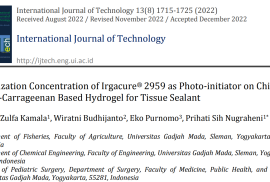
Optimization Concentration of Irgacure® 2959 as Photo-initiator on Chitosan-Kappa-Carrageenan Based Hydrogel for Tissue Sealant

InformationPublication Monday, 2 January 2023

Optimization Concentration of Irgacure® 2959 as Photo-initiator on Chitosan-Kappa-Carrageenan Based Hydrogel for Tissue Sealant

Fiskina Zulfa Kamala, Wiratni Budhijanto, Eko Purnomo, Prihati Sih Nugraheni

Hydrogel is a three-dimensional network of hydrophilic polymers widely used in the biomedical field, one of which is a tissue sealant. The material that can be used in the manufacture of hydrogels is chitosan. The ability of chitosan in the formation of hydrogel is still limited by its swelling and adhesive properties, so it requires other materials such as crosslinkers, one of which is kappa-carrageenan which can stabilize and increase the viscosity of the hydrogel. The addition of Irgacure® 2959 as a photo-initiator to the hydrogel can produce free radicals that can bind to the active group of the polymer. This study aims to determine the effect of adding Irgacure® 2959 in the manufacture of hydrogel based on a chitosan-kappa-carrageenan solution formulated as a colon tissue adhesive. The treatments given were the addition of Irgacure® 2959 as much as 0%, 1%, 2%, 3%, and 4%. The characteristics of the hydrogel tested qualitatively (simulation adhesion test), degree of swelling, resistance to water, degree of crystallinity, and ability to inhibit bacterial growth. The addition of Irgacure® 2959 did not show significantly different results from the control that indicating it cannot increase the crosslinking between chitosan and kappa-carrageenan. This is predicted due to the presence of steric hindrance from kappa-carrageenan, causing very limited crosslinking due to the molecular size difference between chitosan and kappa-carrageenan. Further, it is necessary to optimize the ratio of the chitosan and kappa-carrageenan to get the balance ratio that supports the occurrence of cross-linking. read more

Optimization of Irgacure® 2959 Concentration as Photo-Initiator on Chitosan-Alginate Based Hydrogel for Colon Tissue Sealant

InformationPublication Monday, 2 January 2023

Optimization of Irgacure® 2959 Concentration as Photo-Initiator on Chitosan-Alginate Based Hydrogel for Colon Tissue Sealant

Diah Puspitasari, Wiratni Budhijanto, Eko Purnomo, Prihati Sih Nugraheni

Tissue sealant is a material that is used as an adhesive to bond two tissue surfaces used during surgery. Chitosan and alginate are natural macromolecules used to manufacture hydrogels as tissue sealants because these two materials can strengthen bonds and the mechanical properties of tissue sealants. Irgacure® 2959, as a photo-initiator, can strengthen the cross-linking between chitosan-alginate to produce a tissue sealant with good mechanical strength. Therefore, this study aims to determine the effect of adding Irgacure® 2959 to chitosan-alginate hydrogel with different concentrations as a tissue sealant designed for the colon. The experimental design used a completely randomized design (CRD) with the addition of Irgacure® 2959 0; 1; 2; 3; 4%. The characteristics of the hydrogel as a tissue covering observed in this study include the degree of swelling, water resistance, simulated adhesion, degree of crystallinity, and ability to inhibit bacteria. The results of this study showed that the addition of 4% Irgacure® 2959 reduced the degree of swelling, increased the hydrogel’s resistance to water, and increased adhesion. The interaction of chitosan and alginate with the addition of Irgacure® 2959 produces cross-links, as evidenced by a degree of crystallinity of 26.21%. Based on these results, the chitosan-alginate hydrogel with the addition of Irgacure® 2959 showed good potential in tissue sealant formulations, even though the inhibition of bacteria in all treatments showed low results, namely < 5 mm. read more

Publication in year 2022

InformationNewsPublication Tuesday, 27 December 2022

In 2022, FPT-SP actively publish in both national and international reputated journal as follows:

The effect of different drying methods on antioxidant compounds and fucoxanthin content of brown seaweed from the intertidal zone of West Aceh, Indonesia [2022] Mohamad Gazali, Muhammad Nursid, Amir Husni, Nurjanah, Neviaty P. Zamani, Zuriat, Citra Dina Febrina, Nabil Zurba, Hasanuddin Husin, Dio Hidayat Effect of Homogenization Process on the Production of Arthrospira platensis Carotenoid Nanocapsules Encapsulated with Arabic Gum and Whey Protein Concentrate [2022] K Alfionita, SA Budhiyanti, N Ekantari Jurnal Ilmiah Perikanan dan Kelautan 14 (1), 12-24 Formulation and stability of Ulva lactuca fatty acid oil in water (O/W) microemulsion [2022] Y. P. Ningrum, S. A. Budhiyanti Food Research 6 (4), 120-127

Optimization of Medium Composition for Streptomyces sp. PB2 Chitinase Production using Response Surface Methodology read more

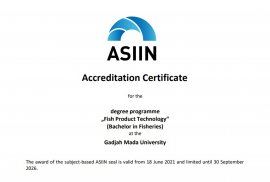
Congratulation, Bachelor in Fish Product Technology is awarded ASIIN accreditation for full 5 years

AnnouncementInformationInternational ActivitiesNews Sunday, 11 July 2021

The long wait after the ASIIN assessment has finally been answered. We are proudly announcing that Bachelor in Fish Product Technology (BFPT), Departement of Fisheries UGM are awarded ASIIN accreditation for full 5 years. With a successful program accreditation, ASIIN confirms that a study program meets a high-quality standard. The quality of a study program is determined by the formulation of relevant objectives by the applying university itself. The quality is also determined by the success that graduates achieve in their profession. read more

ANNOUNCEMENT OF STUDENT EXCHANGE SUPPORT PROGRAM (SCHOLARSHIP FOR SHORT-TERM STUDY IN JAPAN) FY2021

Information Friday, 26 February 2021

download program guideline

2nd Semester Courses Input Schedule

Information Friday, 29 January 2021

Second semester academic year 2020/2021 will soon begin, please be aware for the course input schedule. Input can be done through SIMASTER UGM

Corona Virus Alert

Research Activity Adjustment due to Covid-19

Information Friday, 20 March 2020

For all respective student, due to the Covid-19 pandemic, FPT-SP will adjust all research activity by referring on the Rector Decree (download). Please contact the respective Head of Laboratory for further information and regulations.

Link

 aspirations and feedback
aspirations and feedback


Recent Posts

  • FPT-SP lectures got best presenter award
  • Impact of Enzymatic Hydrolysis on Antioxidant Activity of Snakehead Fish (Channa striata) Head Protein Hydrolysate
  • Production, purification and characterization of chitinase from Micromonospora sp. AR17
  • In Vitro α-Amylase and α-Glucosidase Inhibitory Activity of Green Seaweed Halimeda tuna Extract from the Coast of Lhok Bubon, Aceh
  • Optimization Concentration of Irgacure® 2959 as Photo-initiator on Chitosan-Kappa-Carrageenan Based Hydrogel for Tissue Sealant

Archives

Universitas Gadjah Mada

Jl. Flora Gedung A4, Bulaksumur,

Caturtunggal, Kec. Depok, Kabupaten Sleman,

Daerah Istimewa Yogyakarta 55281

(0274) 551218
fish@ugm.ac.id

Download

Module Handbook

Manual Procedure Examination

Manual Procedure for Field Work

Manual Procedure for Undergraduate Thesis

Student Community Cervices Guide Book

Leaflet

Indonesian Society for Fisheries Processing Technology

Go to Website


Journal of Fisheries Sciences

Go to website


© Universitas Gadjah Mada

KEBIJAKAN PRIVASI/PRIVACY POLICY